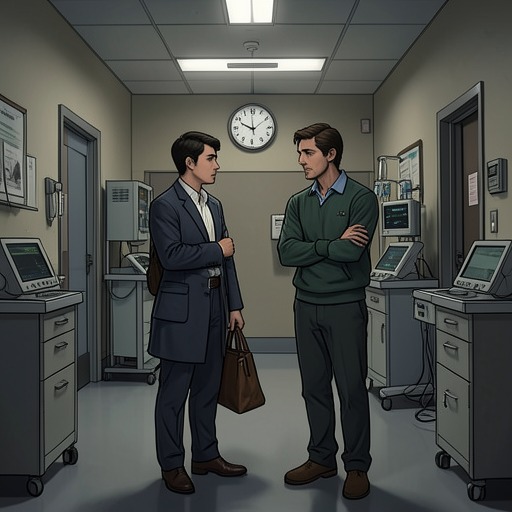
The breakdown of Kay and H’s relationship
This Is Going to HurtThe breakdown of Kay and H’s relationship is presented not as the result of one decisive quarrel but as the eventual consequence of a life repeatedly reorganized around hospital work. Across Adam Kay’s diary entries, affection remains visible in small acts and occasional shared celebrations, while shifts, fatigue, and the inability to make plans steadily consume the time a partnership needs. When the relationship ends, Kay is still working late; the diary’s plain account makes the hospital schedule part of the breakup’s immediate setting, without claiming it was the only cause.
Early Partnership and Unequal Time
At the beginning of Kay’s medical career, H is his partner and appears as a source of practical care: on Kay’s first day, H has made him a packed lunch. That ordinary preparation establishes a domestic intimacy alongside the new equipment and unfamiliar routines of the job. The relationship is present from the outset, but so is the work that will increasingly govern when the couple can see one another.
The imbalance becomes explicit in December 2004. Completing a form about extra hours, Kay calculates that he has worked ninety-seven hours that week and seen H for less than two. The detail turns the abstract pressure of a demanding job into a measure of lost companionship: the problem is not simply that work is tiring, but that it occupies nearly all the available time. The diary records the disparity early, before the later entries show how often it recurs.
The same pattern intrudes on holidays and domestic occasions. One Christmas, Kay has eight missed calls from H and a message wishing him a merry Christmas, without a kiss. They are to celebrate together on Kay’s next day off, 6 January; he tries to make the delay easier with a joke about the bargains on Christmas crackers. His humor acknowledges the inconvenience without resolving it. The celebration is not cancelled outright, but even a shared holiday has to be moved to fit the rota.
Plans Repeatedly Displaced by Work
The diary gives the strain particular shape through occasions that cannot be recovered. In July 2005, Kay has to cancel at the last minute on Ron’s stag do, losing £400 and a T-shirt printed with Ron’s face. He has tried to swap shifts, but the replacement falls through. He remains on the ward, sober, while friends struggle to understand why plans made in advance are so often abandoned. He sends Ron an unaffordable bottle of whisky as an apology and arranges to meet after his night shifts, while taking on extra hours to cover the cost. The episode concerns his friendship with Ron, but it also shows the wider structure of the life H shares with him: promises to loved ones are continually made conditional on staffing and shifts.
In August 2006, a parcel intended as H’s birthday present becomes another small but telling casualty of the schedule. Kay has carried the Post Office card for two weeks, repeatedly checking it and hoping for a day when he can leave work early. The Post Office will hold the parcel for eighteen days, and he is at work throughout that period; it is returned, and H will not receive the present the next day. The missed gift is not presented as a grand rupture. Its significance lies in the practical chain behind it: even collecting something already bought for H proves impossible.
Work also intrudes on the couple’s home life through the pressure surrounding a flat they are trying to buy. After the owners withdraw from the sale, Kay suspects they prefer a buyer with more money, and he and H are left with several thousand pounds in legal fees and survey costs. He has learned the details of the property but will never live in it. The failure of the purchase adds a separate source of strain to a period when the relationship is already tense; the diary places the financial and domestic disappointment beside, rather than reducing it to, the pressures of Kay’s job.
Attempts to Preserve Intimacy
The entries do not portray the relationship as devoid of closeness. In July 2008, Kay and H are preparing for a two-week holiday to celebrate five years together. He looks forward to being far from the labour ward and hopes they can inhabit a relationship not sustained by apologetic text messages. The hope itself conveys how much ordinary contact has been displaced: a holiday abroad is imagined as a chance to recover a form of togetherness that daily life has made difficult.
That plan is immediately compromised when Kay receives an email requiring him to work the holiday’s middle weekend. No colleague can swap with him. Other doctors have returned early from honeymoons or missed family funerals, and the suggested workaround is for him to travel roughly 6,000 miles back to England for the weekend. The absurd distance underlines how little the rota accommodates the couple’s plans. The diary does not say that the holiday is entirely abandoned, but it does show that even an anniversary trip is not protected from the hospital’s staffing needs.
There are occasional returns to shared celebration. In February 2010, Kay notes that it is the first Valentine’s Day he has spent with H in four years. They have dinner at a Thai restaurant; Kay eats one of the sweets brought to their table before realizing it is a candle. The comic mishap gives the evening an affectionate, domestic particularity, while the four-year interval makes clear how unusual the occasion is. A dinner together matters partly because it has been so difficult to arrange.
A later Saturday brings the conflict into direct view. Kay goes into work after a major operation because he is anxious that something may have gone wrong and wants to check on the patient. H asks whether he is having an affair. The patient is fine, and Kay says he has come only to check; he is also concerned not to imply that the doctor already caring for the patient is untrustworthy. On the drive home, he reflects that he would be too tired to take off his trousers even if he wanted an affair. The entry presents suspicion and exhaustion together: his absence can look like a choice against the relationship, while he experiences it as work-related worry and depletion.
Friction, Absence, and Separation
By July 2010, the diary records a more direct confrontation over the costs of Kay’s job. Ron tells him that he uses work as an excuse and points to missed occasions: the stag do, the first half of Ron’s wedding, Ron’s father’s funeral, and his daughter’s christening. Kay insists that he loves Ron and recognizes that he has been a poor friend, while arguing that the job is relentless and that he has still seen Ron more than almost anyone else. He admits that he lied about the christening. This exchange is not evidence of H’s own judgment, but it clarifies the pattern surrounding the couple: professional demands have repeatedly displaced relationships beyond the home, and Kay’s explanation of those absences does not undo their effects.
The tension between work and private life appears again in September, when Kay has a date night planned with H after working through the previous six date nights. Five minutes before he is due to go home, an emergency requires an operation. He weighs a longer keyhole procedure, which would leave the patient more comfortable and allow her home the next day, against a quicker conventional operation that would leave a scar and require several days in hospital. The faster option would let him leave on time and keep H happy. He pauses, then chooses the operation he considers right for the patient, accepting that this means bad news for himself. The scene makes the conflict concrete: the lost evening is not simply a scheduling mishap but the consequence of a professional decision that places patient welfare ahead of a promised night together.
In November 2010, Kay is meant to be home at seven in the evening but leaves the labour ward at 9:30. Work means he has to text H to cancel picking up all his belongings from their house. By then, they have broken up, and he is living in a tiny flat ten minutes from the hospital. The entry connects the separation to an immediate practical change: a shared home has become somewhere from which he must collect his things, and the new flat’s closeness to work is the one advantage he names. It does not set out a single argument or assign the breakup exclusively to the rota; instead, the late departure and cancelled collection place the end of the relationship within the same pattern of work overrunning private arrangements.
Meaning in the Diary’s Wider Arc
The relationship’s trajectory is built through recurring contrasts rather than a continuous account of life at home. H’s packed lunch, the delayed Christmas, the returned birthday parcel, the rare Valentine’s dinner, and the cancelled date night are separate moments, but together they trace how care and intention repeatedly meet a schedule that cannot reliably make room for them. Humor softens some entries, yet it also measures the limits of that accommodation: jokes can make a postponed celebration bearable for a moment, but they cannot return the time that work has taken.
The breakup is also part of a broader record of professional demands reshaping Kay’s personal life. His missed commitments to Ron make visible that the pressure is not confined to his partnership with H, while the later account of the labour ward crisis shows how the consequences of work extend beyond timekeeping into his sense of himself as a doctor. The diary does not establish that the crisis caused the separation. It does, however, place the relationship’s end within a life in which work continues to take precedence in practice, even when Kay recognizes what that precedence costs. The final image of the November entry is therefore deliberately modest and stark: not a reconciliation or a definitive explanation, but a newly separate home close to the hospital that has occupied so much of the life before it.